 Fardin AdonisVIEW PROFILE →
Navigating the Inflation Cliff: A Comprehensive Macroeconomic Analysis of the July CPI Print Across Global Markets
As global financial markets brace for the release of the July Consumer Price Index (CPI) report, macro-investors and central banks find themselves at a critical inflection point. With Wall Street's consensus locked firmly at 3.4% for headline year-over-year inflation, market structures are coiled ti
Introduction: The Macroeconomic Crucible of 2026
We stand at a critical crossroads in global economic history. As central banks across the developed and developing world navigate the delicate, high-stakes transition from aggressive monetary tightening to a sustainable, growth-friendly posture, macroeconomic data points have transformed into major market-shaking events. Among these, the Consumer Price Index (CPI) remains the ultimate barometer of economic health, purchasing power stability, and monetary policy trajectory.
Today, financial markets find themselves coiled tightly, awaiting the release of the July inflation figures. With structural shifts occurring across global supply chains, energy markets, and sovereign debt portfolios, the upcoming CPI print is not merely a statistical update; it is the fundamental pivot upon which capital allocation, risk management, and asset valuations will rest for the remainder of the third quarter. Understanding the intricate mechanics behind these numbers requires an exhaustive look into institutional forecasts, structural cross-currents, and the cascading impacts across global equity exchanges, digital assets, and precious metals.
1. Deep-Dive Structural Analysis of the Institutional Forecast Matrix
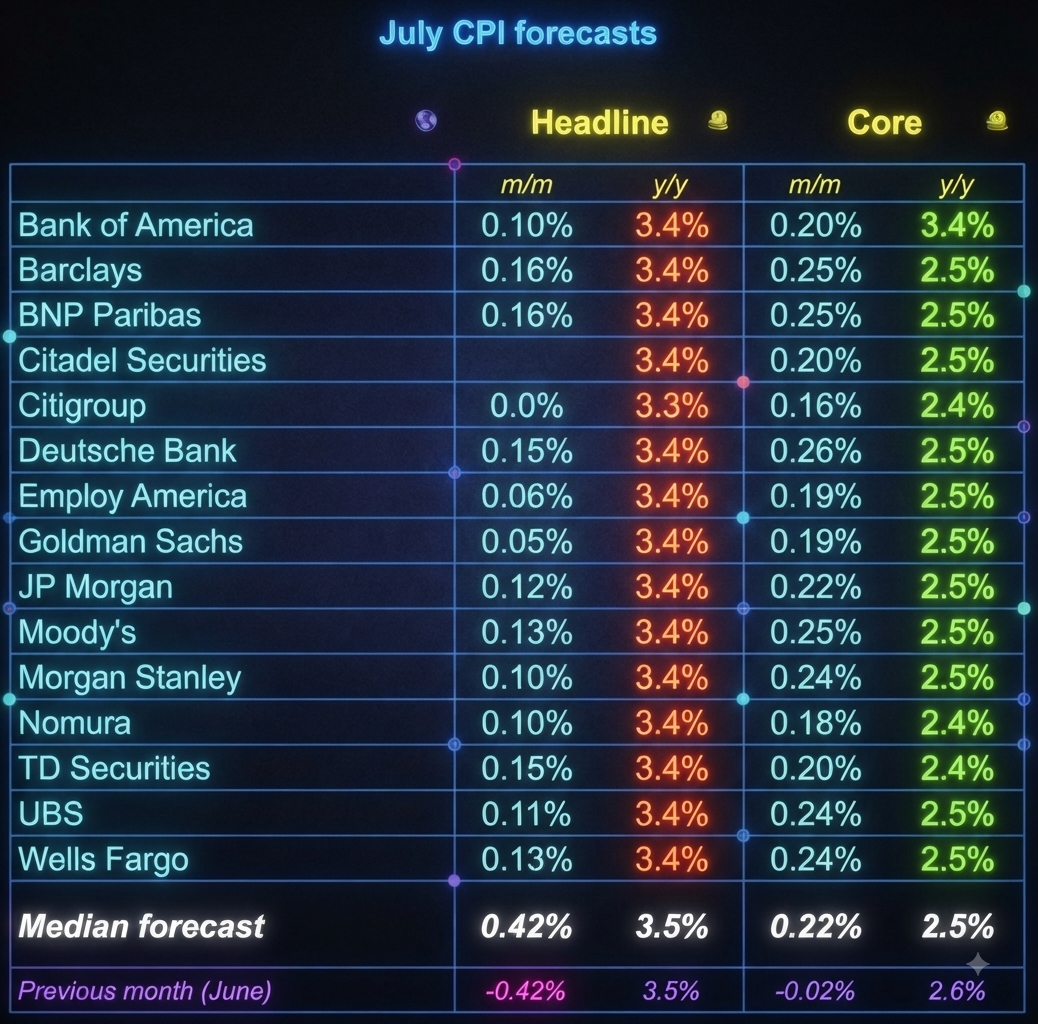
To accurately project market reactions, we must first dissect the institutional forecasting data presented in the July CPI survey matrix. This dataset offers a rare window into the collective psychology and mathematical models of the world's premier financial powerhouses:
The Headline Year-over-Year (y/y) Unified Consensus: The matrix reveals a striking, near-unanimous institutional consensus. Financial giants including Bank of America, Barclays, BNP Paribas, Citadel Securities, Deutsche Bank, Goldman Sachs, JP Morgan, Moody’s, Morgan Stanley, Nomura, TD Securities, UBS, and Wells Fargo have all locked their headline annual inflation projections precisely at 3.4%. This reflects a calculated cooling from the previous month (June), which printed at 3.5%.
Deep Economic Implication: Such a rigid, uniform consensus implies that the 3.4% figure is completely and thoroughly priced into global asset valuations. Markets do not reward the expected; they trade on the unexpected. Therefore, a print of 3.4% will initiate a neutral "non-event" baseline response, shifting immediate attention to secondary structural metrics.
The Outlier Matrix (Citigroup & Structural Divergence): Breaking the rigid wall of consensus, Citigroup projects headline annual inflation at a cooler 3.3%, supported by a monthly headline change (m/m) of 0.0%. Furthermore, institutions like Nomura and TD Securities point toward core annual inflation cooling as low as 2.4%, diverging from the median consensus of 2.5%.
Deep Economic Implication: These outliers represent the "fat-tail" probability of a faster-than-expected disinflationary impulse. If Citigroup's projection proves correct, it signals that structural price pressures are dissolving quicker than central bank models anticipate, opening the door for an aggressive dovish repricing.
Core CPI Nuances and Velocity (m/m vs y/y): The median forecast for core annual inflation (stripping out volatile food and energy) sits at 2.5% (down from June’s 2.6%), while monthly core inflation (m/m) is anticipated to print at 0.22%.
Deep Economic Implication: The deceleration in core metrics indicates that underlying inflationary stickiness—the primary bugbear of central bankers—is steadily losing momentum, providing a mathematical justification for forthcoming policy easing.
2. Comprehensive Scenario Analysis: Granular Market Impact Modeling
Given the structural framework established by the institutional forecast matrix, we must rigorously model how global markets will react under three distinct statistical outcomes.
Scenario A: If CPI Prints Below Consensus (<= 3.3% / The Goldilocks Shock)
If the data surprises to the downside, validating Citigroup's 3.3% projection or lower, disinflation is accelerating.
U.S. Equities (Wall Street):
Deep Breakdown: Growth, high-multiple technology, and small-cap equities (Russell 2000) will experience an aggressive, liquidity-driven rally. Lower inflation compresses U.S. Treasury yields, directly reducing the discount rate applied to future corporate cash flows and inflating equity valuations.
Japanese Equities (Nikkei 225):
Deep Breakdown: Japanese markets will react positively, though buffered by foreign exchange dynamics. A sharp drop in U.S. yields weakens the U.S. Dollar against the Yen, relieving the acute monetary pressure on the Bank of Japan (BoJ) and supporting export conglomerates.
UK Equities (FTSE 100):
Deep Breakdown: Moderate-to-strong capital inflows. Global risk-on sentiment and reduced international borrowing costs ease systemic financial stress for UK multinational banking and commodity-heavy groups.
Chinese Equities (CSI 300 / Hang Seng):
Deep Breakdown: Robust recovery rally. A weakening U.S. Dollar Index (DXY) removes the capital flight pressure from emerging markets, granting Beijing domestic leeway to implement aggressive monetary stimulus without triggering currency depreciation.
Cryptocurrency Complex (Bitcoin & Altcoins):
Deep Breakdown: Explosive, high-beta bullish expansion. Crypto assets function as high-sensitivity liquidity sponges. A sub-consensus CPI signals looser global financial conditions, triggering massive short-squeezes across leveraged derivatives markets.
Precious Metals (Gold):
Deep Breakdown: Sharp upward breakout. Real interest rates collapse alongside the dollar, plunging the opportunity cost of holding non-yielding bullion and drawing heavy institutional safe-haven allocations.
Scenario B: If CPI Prints In-Line with Consensus (3.4% / The Baseline Status Quo)
If inflation prints precisely at the median forecast of 3.4% headline and 2.5% core, no macro surprise is registered.
U.S. Equities:
Deep Breakdown: Short-term algorithmic volatility spikes (whip-saws) followed by an immediate return to baseline trends. Because this outcome is fully priced in, institutional capital re-allocates its focus away from macro data and back toward corporate earnings reports and sector-specific fundamentals.
Japanese and UK Equities:
Deep Breakdown: Neutral positioning. Regional indices decouple from U.S. macro data, remaining tied instead to local corporate guidance and domestic fiscal policies.
Chinese Equities:
Deep Breakdown: Range-bound action. Domestic economic recovery markers—such as real estate stabilization and retail sales data—will dictate market momentum entirely.
Cryptocurrency Complex:
Deep Breakdown: Transient volatility followed by technical consolidation. Assets remain constrained within established technical channels as market participants await the next fundamental catalyst.
Precious Metals:
Deep Breakdown: Stable consolidation. Gold maintains its current structural support levels without dramatic directional deviations.
Scenario C: If CPI Prints Above Consensus (>= 3.5% / The Stagflationary Shock)
If headline inflation prints at 3.5% or higher, proving stickier than projected by Bank of America, Goldman Sachs, and other elite institutions, financial markets face an immediate shock.
U.S. Equities:
Deep Breakdown: Severe, broad-based bearish sell-off. Bond yields spike violently, Treasury prices plummet, and institutional capital flees equities for cash equivalents and short-duration risk-free yields. High-multiple tech stocks bear the brunt of valuation contractions.
Japanese Equities:
Deep Breakdown: Downward pressure. A surging U.S. dollar forces aggressive Yen depreciation, compelling emergency intervention policies and restrictive domestic monetary postures that crush equity valuations.
UK Equities:
Deep Breakdown: Synchronized contraction. Global financial tightening reignites fears of prolonged economic stagnation and corporate debt distress across European credit markets.
Chinese Equities:
Deep Breakdown: Capital flight and sharp correction. A surging DXY triggers rapid capital outflows from emerging markets back into dollar-denominated assets, placing immense downward pressure on mainland and offshore shares.
Cryptocurrency Complex:
Deep Breakdown: Liquidation cascade (Strong Bearish). High interest rates and an aggressively dominant dollar drain speculative liquidity from the ecosystem. Leveraged long positions across Bitcoin and altcoins face automated, cascading liquidations.
Precious Metals (Gold):
Deep Breakdown: Complex divergence. Initially, soaring real yields act as a severe macro headwind for gold. However, if persistent inflation triggers structural fears of long-term economic instability or stagflation, safe-haven demand eventually establishes a sturdy technical floor against catastrophic crashes.
Conclusion
The upcoming July CPI release is far more than a routine data point; it is the definitive fulcrum upon which global asset allocation for the remainder of the third quarter rests. As illustrated by the institutional forecasting matrix, the baseline expectation of 3.4% is universally recognized, but the true alpha and risk reside in the margins of deviation. For professional investors, developers, and macro-analysts navigating the complex global landscape, understanding these granular variances across equity exchanges, digital assets, and commodities is essential for mitigating systemic risk and capturing asymmetric opportunities.